You say you want a revolution? Well, you know... . you might get one if you're a patient Windows user. With Windows' eighth major release (at least according to Microsoft's math), its name is becoming metaphorical. Taking on a default look that is rooted in Windows Phone 7 -- the first "Windows" to eschew windows -- with a smattering of Media Center, the next major version of Windows marks an overhaul of the initial user interface. Indeed, it is even a more radical departure than Apple made between Mac OS X and iOS, which preserved a scaled-down dock and icons, or between Mac OS 9 and Mac OS X.
Apple's and Microsoft's approaches are similar in at least one way -- each has one operating system for PCs and another for phones. Clearly, though, the longtime operating system rivals have taken different tacks with tablets. Apple has approached them as big handsets whereas Microsoft is treating them as somewhat smaller touchscreen PCs. Microsoft will challenge Apple's assertion that bold touch interfaces are not the province of the PC. But while Apple decided to break with tradition on the iPad's platform, Microsoft could not escape its personal computing legacy. To leave the existing base of Windows apps behind would be tantamount to shooting the OS in the head.
This isn't to say that Microsoft didn't have alternatives. One might have been to have different Windows "personalities" depending on the form factor -- a traditional windowed interface for desktops and laptops, a Metro-like UI for tablets, and a Media Center UI for home theater PCs. In fact, with the blurring and adaptability of form factors these could all easily exist in a "schizophrenic" convertible tablet that might look something like the Eee Pad Transformer. It would present a traditional Windows interface with the keyboard attached, the Metro-like UI with the keyboard detached and a Media Center UI when connected to a TV via HDMI or presenting video witlessly.
Such a scenario might provide better user interface consistency, but it would ask a lot of developers. What Microsoft is now calling Windows 8 is no mere skin. The company is enabling app developers to take on a similar appearance and UI conventions to that of the new "desktop." This means that, in the short term, at least, most developers will need to choose between a mouse-centric and touch-centric approach. And because of this, for the foreseeable future, Windows 8 could present a fractured user experience (although of course it will be up to the user to decide whether to use, say, an app with a desktop UI for their tablet PC.). It's going to be an ugly transition, and not just figuratively.
Over the course of Windows 8's run, though, Microsoft will have challenged developers of all kinds to meld the full power and depth of a PC app with the simplicity and discoverability of a finger-friendly tablet UI. The Windows team has laid down the gauntlet at the feet of the Office team, for example -- a contrast to 2007, when the release of Windows Vista arrived in lockstep with a new version of Microsoft's popular productivity suite.
How will Office, Photoshop, AutoCAD, and other advanced applications adapt? Will it be possible to have any kind of common UI between an optimized Windows 8 experience and Macs? If Microsoft can bring Windows developers along as it shifts the fundamental principles of Windows' UI in Windows 8, the new windows the operating system opens may provide a glimpse of a future user interface.
Monday
As Windows loses its windows
ComScore: Android grows larger than ever among US subscribers, Apple belittles RIM
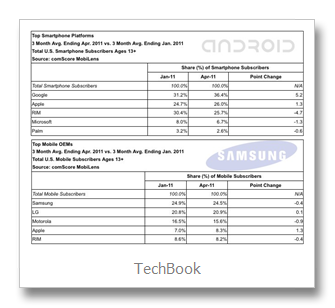
The latest ComScore results from the last quarter are in, and the US mobile device wars were hotter than ever as 13% more people reported owning a smartphone. Google conquered most users' territory with Android climbing just over five percent (now totaling 36.4%) and still claiming first for mobile software platforms. Apple's iOS destroyer took second place (at 26%) partially due to RIM's S.S. BlackBerry OS sinking about five percent (now 25.7%) to claim third, while Microsoft and HP / Palm rounded out the bunch struggling to stay in the fight with even lower single-digit scores. In the OEM region Samsung claimed first yet again (although slightly dropping to 24.5%), with LG and Motorola landing in second and third respectively, each keeping its place from the prior quarter. In the last two slots, Apple again bested RIM whose devices barely dropped half of a percent, but enough to let the slight growth of iDevices snatch up 4th. The source link below is waiting to be clicked if you want the full battle statistics.
Tech evangelist touts Windows Phone 7 as the "most secure" smartphone OS
Android and iOS have Windows Phone 7 squarely beaten when it comes to adoption rates. But the recent security threats and privacy issues surrounding Android and iOS may work in Microsoft's favor. Dave Northey of Microsoft Ireland explained to Silicon Republic why he thinks Windows Phone 7 is the "most secure" smartphone OS on the market.
Northey explains that WP7 is inherently more secure, because of memory compartmentalization: "We keep applications away from the bones of the OS. When an application fires up, the OS will give it a dynamically allocated security bubble, for lack of a better word, and every app has its own one of those."
These 'security bubbles' are in contrast to both Android and iOS, in which some apps have been found to steal information from one another. Northey says that "there's no other smartphone on the market that's as secure."
When WP7 was released, it was promoted as a multimedia device for the average consumer. But Northey is optimistic about the announcement of more enterprise features in the Mango update. But will it be enough to make Windows Phone 7 competitive with iOS and Android? Given the increasing concerns about mobile security, this could convert a lot of enterprise customers. And then we'll see the average consumer follow suit, a la BlackBerry.
Mad Catz' exclusive Xbox 360 wireless headphones revealed
According to IGN, the new Mad Catz Warhead 7.1 will get everything it needs from a base station connected to your console. String USB and optical cables directly from the Xbox 360 to that tiny tower above, and you'll reportedly get enough 5.8GHz bandwidth to deliver virtual Dolby surround sound to four pairs of headphones at once -- plus wireless Xbox LIVE audio chat thanks to some native support from Microsoft. What's more, the USB base station will also give you an on-screen battery readout, and if the Warhead runs out of juice, you'll find a second swappable battery pack sitting in the base station's charger. If that sounds too rich for your blood, the Devastator will ditch the surround sound and rechargeable batteries while retaining the same connectivity and 50mm drivers of its premium brother. How much that'll cost you is still to be determined, though Mad Catz told IGN they'll all ring up under $300 this holiday.
Saturday
Google Apps is moving on, you'll need an HTML5 browser to go with it
HTML5 beckons the world with its dashing logo and also, we suppose, all the clever little things it can do. Desktop notifications in Gmail and folder-dragging in Docs already refuse to work with anything less -- and before long that will apply to the entirety of Google Apps. Come August 1st, you will find that Gmail, Calendar, Talk, Docs and Sites are all unsupported unless you're using either the current or last major release of Internet Explorer, Firefox, Chrome or Safari. An older browser won't suddenly stop working with Google Apps, but it will begin a steady descent into oblivion. Hey, being popular means you don't have to be nice.
Analyst says that Apple's iCloud could seriously damage RIM
If the name Shaw Wu sounds familiar, that is because he is the analyst who continually wrote clients to tell them that a Verizon branded Apple iPhone was coming. Wu, who now toils for Sterne Agee, told clients on Friday that Apple's soon to be introduced iCloud is a game changer that will make it tough for other manufacturers to compete with the Cupertino based firm.
The new service, expected to be introduced Monday, will make iTunes more powerful according to Wu, who says that it can hurt Google, Amazon, Microsoft and RIM. While all of the aforementioned companies have tried to compete with iTunes,Wu sees iCloud making life especially difficult for RIM. Why? Because RIM offers its own "push" network for users of BlackBerry phones. While iCloud won't offer all of the same services that BlackBerry does, it will relieve some of the traffic congestion that carriers face by offloading data processing and as we reported the other day, the service will begin life free to users.
After speaking to industry contacts, Wu told clients that iCloud could impact RIM's forward service revenue and gross margin. Currently, carrier payments offer RIM gross margins as high as 87%. With that kind of profitability in danger, Wu has cut his revenue estimates for the Canadian based company to $24 billion (US) for the 2012 fiscal year, a drop of $100 million from his previous figure. Even more damaging, Wu now expects the BlackBerry maker to produce earnings of $6.35 a share, down from the $6.65 originally estimated. With this in mind, the analyst has cut his target on RIM's stock to $44 from $52. Friday morning, the stock was trading at $39.83.
Monday, Apple CEO Steve Jobs is expected to introduce the iCloud service during his keynote speech at the WWDC in San Francisco. A banner showing the iOS icon for iCloud is already hanging at the Moscone center where the WWDC will be held.
Apple camera patent could stop smartphone bootleggers in their tracks
Apple is always filing patents for strange and fantastic things that never seem to find their way into actual products. But an application published today details some interesting tech that we could actually see getting jammed into a future iPhone (for better or worse). By pairing an infrared sensor with the camera already on board, portable devices could receive data from transmitters placed, well, wherever. Beyond simply blasting out text and opening links like a glorified QR code, transmitters could disable certain features, such as the camera, to prevent recording at movie theaters and music venues. If completely shutting off the cam seems a bit heavy-handed, watermarks can also be applied to photos identifying businesses or copyrighted content. Some potential uses are a little less Big Brother, like museums beaming information about exhibits to a user's or launching an audio tour. Obviously third parties would have to get behind the IR push and there's no guarantee that Apple will put this in a future iProduct. Still, we're a little worried that the days of blurry YouTube concert videos may be coming to an end.